A quick outline before we get into it
- Why extraction technology matters more than most buyers expect
- The main process steps that shape powder quality
- How extraction choices affect purity, peptide profile, stability, and functional value
- What buyers should ask suppliers before placing an order
- A practical takeaway for supplement, nutraceutical, pharma, and cosmetics teams
- FAQs
When buyers talk about earthworm protein powder quality, they often start with the spec sheet. Protein content, moisture, mesh size, microbiology, heavy metals. Fair enough. Those are essential.
But here’s the thing: the real story usually starts earlier, inside the extraction process.
Two powders can look similar in a drum, show similar protein percentages on paper, and still behave very differently in formulation, digestion, odor control, stability, and end-use positioning. That gap usually comes back to extraction technology. Not marketing. Not fancy labels. Process.
And in this category, process really is product.
Research on earthworm protein shows that extraction conditions can sharply change purity, fat removal, peptide generation, and downstream bioactivity. In one study, an alkaline-soluble, acid-precipitation process produced earthworm protein with 96.03% protein and reduced fat to 0.98%, which is a major quality shift from the starting raw material. The same work also showed that further digestion generated soluble peptides with measurable antioxidant activity.
So, if you’re sourcing for dietary supplements, nutraceuticals, functional foods, pharmaceutical ingredients, or even advanced cosmetic concepts, extraction technology is not some back-room manufacturing detail. It is one of the main drivers of commercial quality.
It starts earlier than extraction, honestly
Before the actual extraction step, raw material handling already sets the tone.
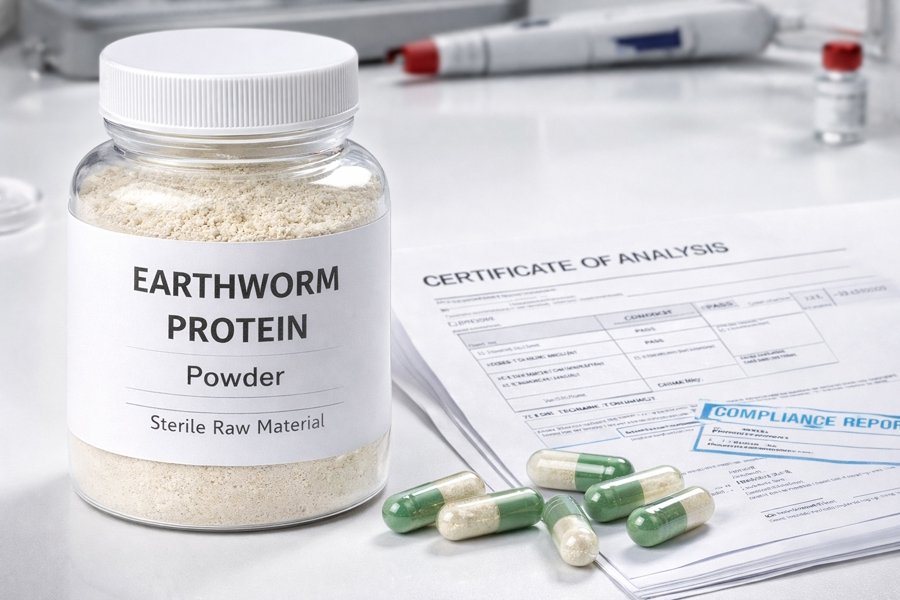
One uploaded production-flow document describes a sequence that includes selection, mechanical separation of worms from soil and impurities, second-stage cleaning, mechanical washing and hydrolysis, centrifugal filtration, low-temperature drying, milling, sterilization, and packaging.
That sounds basic, maybe even routine. But it matters a lot.
Why? Because earthworm-derived ingredients are unusually sensitive to upstream contamination, off-odor formation, and quality drift. If raw material cleaning is weak, later extraction has to work harder. If separation is sloppy, non-protein impurities can stay in the system longer. If drying is too aggressive, you may end up protecting shelf life while damaging the functional profile you wanted to preserve in the first place.
So yes, buyers should ask about extraction. But they should also ask what happens before extraction and what happens immediately after it.
That’s where quality gets won or lost.
Alkaline extraction can improve purity, but it needs control
One of the clearest examples from the uploaded research is the alkali-soluble, acid-precipitation route.
In the Food Chemistry paper, dried earthworm powder was mixed with water, adjusted to pH 11, ultrasonicated, extracted with stirring, centrifuged, then acidified to pH 4.5 to precipitate protein, followed by neutralization, dialysis, and freeze-drying. That method yielded earthworm protein with 96.03% protein purity while cutting fat content to 0.98%.
From a buyer’s point of view, that has obvious appeal.
Earth Worm Protein
Earthworm Protein Powder is a premium functional protein extracted from earthworms through scientific processes. Rich in collagenase, fibrinolysin, lumbrokinase, Fibrinolytic…
Higher purity can mean:
- easier formulation standardization
- cleaner positioning for premium products
- lower interference from non-protein fractions
- better consistency across batches
But there’s a catch. Actually, more than one.
Alkaline extraction is effective, yet it has to be carefully managed. Overly harsh pH, long holding times, or poor neutralization control can affect protein structure. And when protein structure shifts too far, performance can shift too. Solubility may change. Digestibility may change. Sensory properties may change. Bioactive fraction availability may change.
So the question is not “Does the supplier use alkaline extraction?” The better question is “How tightly do they control pH, temperature, time, and downstream recovery?”
That’s a very different conversation. A better one too.